Study Sites

AQUEDUCT Study Site – Beni Khalled Citrus Orchard (Tunisia)

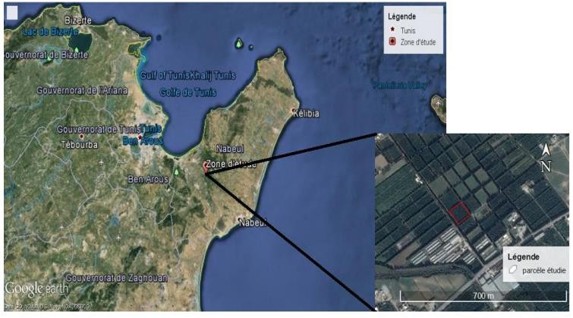
The Beni Khalled study site is located at the Citrus Technical Center in the Cap Bon region of northeastern Tunisia. It represents an intensive Mediterranean citrus production system monitored for agro-climatic and ecohydrological processes. Within the AQUEDUCT project, this site provides valuable data on crop water use, irrigation efficiency, and microclimatic dynamics in irrigated orchards.
Location and Physical Characteristics

  • Country: Tunisia

  • Region: Cap Bon – Beni Khalled

  • Study area: Citrus orchard within the Citrus Technical Center

  • Total citrus production area: approximately 4,080 ha

  • Climate: Mediterranean climate

The orchard is characterized by sandy soils with more than 70% sand content, which strongly influences soil water dynamics and irrigation management.

Climate Conditions

Meteorological data have been continuously monitored since 2014.

  • Average annual temperature: ~19°C

  • Annual rainfall: highly variable, between 250 and 750 mm

Role within the AQUEDUCT Project

  • Within the AQUEDUCT project, the Beni Khalled site contributes to:

    • Monitoring crop water use in Mediterranean citrus systems

    • Evaluating irrigation efficiency under drip irrigation

    • Studying soil moisture dynamics in sandy soils

    • Supporting water accounting approaches for irrigated agriculture

Orchard Characteristics

  • Crop: Citrus (navel orange varieties)

  • Main varieties:

    • Navelina

    • Newhall

    • Washington Navel

    • Lane Late

  • Orchard age: approximately 20 years

  • Planting density: 4 × 5 meters

  • Wind protection: Cupressus trees used as windbreaks

Irrigation System

The orchard is equipped with a drip irrigation system, allowing efficient water delivery directly to the root zone and supporting detailed monitoring of irrigation practices.

Agro-Climatic Monitoring
  • An agro-climatic station (iMetos) installed at the Citrus Technical Center records:

    • Global radiation

    • Air temperature

    • Relative humidity

    • Wind speed

    • Rainfall

    These observations support the analysis of crop water requirements and microclimate variability.

Soil Moisture Monitoring

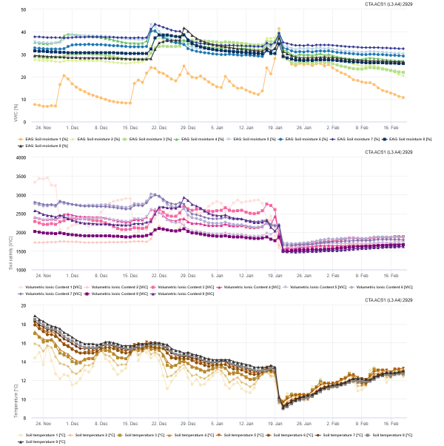
he experimental plot (Nova A6) is equipped with multiple soil moisture sensors:
Drill & Drop Sensors (Sentek – FDR)

  • Two probes reaching 90 cm depth
  • Measurements every 10 cm
  • Variables measured:
  • Soil moisture content
  • Volumetric ionic content
  • Soil temperature
CS616 Sensors (Campbell Scientific – TDR)

–  Four probes measuring:

  • Output signal period
  • Soil temperature

These sensors allow detailed monitoring of soil water dynamics within the citrus root zone.